Disclosure: ClearPick Digest is supported by its readers. If you buy through links on this page, we may earn a commission at no extra cost to you. Read our affiliate disclosure.
Executive Summary
- Wi-Fi offers plug-and-play simplicity for high-bandwidth devices (like cameras), but clutters your home router and drains batteries quickly.
- Zigbee delivers rock-solid, ultra-low-power local mesh networking for sensors and switches, though it requires a dedicated hub or bridge.
- Matter is an interoperability application layer—not a standalone wireless radio—running primarily over Wi-Fi and Thread to eliminate vendor lock-in.
Architectural Breakdown: How Each Protocol Handles Data
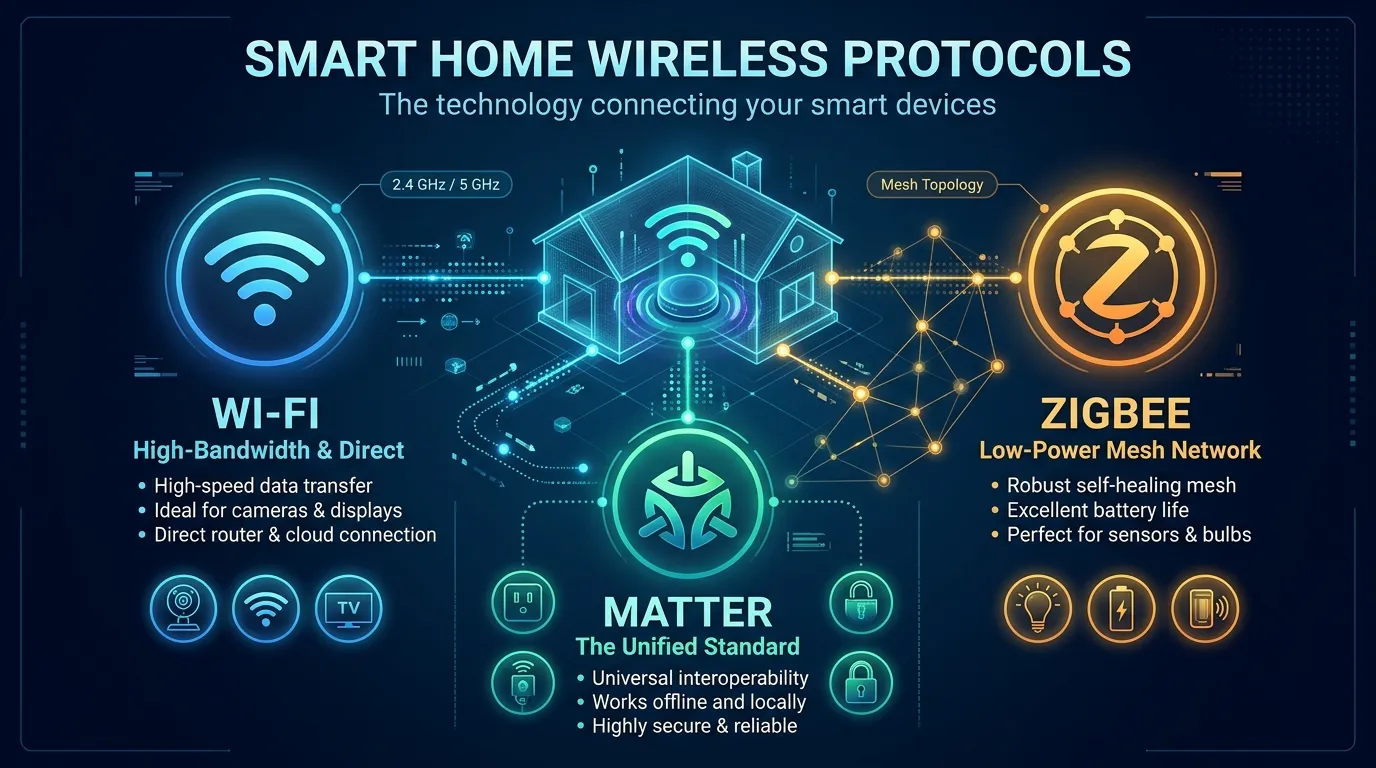
Choosing the right foundation comes down to understanding network architecture. In a standard zigbee vs matter vs wifi smart home evaluation, the primary difference lies in how devices communicate with each other and your local network.
Wi-Fi Topology:           Zigbee / Thread Mesh Topology:
[Device] -> [Router]      [Sensor] -> [Smart Plug (Router)] -> [Hub / Coordinator]
[Device] -> [Router]          ^             |
[Device] -> [Router]          +--- [Switch]-+
Wi-Fi: Star Topology and Bandwidth Heavyweights
Wi-Fi connects every smart accessory directly to your access point in a star topology.
- The Advantage: Zero extra hardware required. You buy a smart plug, enter your network password, and it works immediately with cloud services or mobile apps.
- The Drawback: Scalability issues. Most standard residential routers struggle when client counts surpass 40 to 50 active devices. Furthermore, Wi-Fi radios consume significant power, making them unsuitable for coin-cell battery sensors.
Zigbee: Dedicated Low-Power Mesh
Zigbee operates on the IEEE 802.15.4 standard, completely separated from your primary local area network traffic.
- Mesh Architecture: Mains-powered Zigbee devices (like wall switches and smart plugs) act as repeaters, relaying signals across long distances. Battery-powered sensors sit on the edges of this mesh.
- Local Reliability: Zigbee commands execute locally through a hardware coordinator. Even if your internet connection goes down, motion-activated lights and wall switches continue to trigger instantly.
Where Matter Fits into the Smart Home Landscape
A common misconception is treating Matter as a direct competitor to Zigbee or Wi-Fi radios. Matter is an application-layer protocol, whereas Zigbee and Wi-Fi define the physical and transport layers of communication.
Matter operates over existing networking technologies:
- Wi-Fi and Ethernet: Used for high-bandwidth devices like smart displays, streaming boxes, and appliances.
- Thread: A low-power, IP-based mesh radio technology that shares the same underlying physical radio standard (IEEE 802.15.4) as Zigbee.
Because Matter runs on standard Internet Protocol (IPv6), it bridges disparate smart home platforms. A Matter-certified device works natively across Apple Home, Google Home, Samsung SmartThings, and Home Assistant without custom manufacturer plugins.
If you invest in Matter today, you are typically choosing between Matter-over-Wi-Fi (for mains-powered gear) and Matter-over-Thread (for compact sensors, locks, and blinds).
Performance, Power, and Network Reliability Compared
| Metric | Wi-Fi | Zigbee | Matter (over Thread) |
|---|---|---|---|
| Typical Latency | 100ms – 500ms (often cloud-reliant) | 10ms – 30ms (strictly local) | 15ms – 40ms (strictly local) |
| Power Consumption | High (days to weeks on battery) | Extremely Low (1–3 years on CR2032) | Extremely Low (1–3 years on CR2032) |
| Router Overhead | High (consumes IP addresses) | Zero (single hub IP address) | Low (Thread uses Border Routers) |
| Self-Healing Mesh | No (star topology) | Yes (mains-powered nodes repeat) | Yes (self-organizing routing) |
| Cross-Platform Setup | Varies (often proprietary apps) | Requires bridge per ecosystem | Unified via QR code / Commissioning |
Power Consumption and Latency
For contact sensors, temperature monitors, and wireless buttons, power efficiency dictates usability. A Zigbee or Thread door sensor can run for multiple years on a single coin-cell battery because the radios sleep until triggered. A Wi-Fi equivalent requires larger AAA batteries and frequently drops offline to preserve battery life, resulting in noticeable latency spikes when woken up.
Network Congestion
Every Wi-Fi smart bulb consumes a DHCP lease and radio airtime on your 2.4 GHz channel. As your setup scales beyond 30 bulbs and switches, you risk packet collision and dropped connections. Zigbee removes this traffic from your router entirely, centralizing communication through a single bridge.
Decision Framework: Which Standard Should You Pick?
To determine the right protocol for your home, match the standard to the specific job instead of forcing a single technology across your entire setup.
Choose Wi-Fi When:
- You are starting small with fewer than 10 total smart devices.
- You are installing high-bandwidth hardware such as video doorbells, indoor security cameras, or robotic vacuum cleaners.
- You do not want to manage standalone coordinators, bridges, or ecosystem hubs.
Choose Zigbee When:
- You prioritize maximum reliability, ultra-low latency, and fully offline, local automations (ideal for Home Assistant users).
- You want access to an extensive, mature catalog of budget-friendly sensors, relays, and smart bulbs.
- You prefer keeping all smart peripheral traffic isolated from your primary home Wi-Fi network.
Choose Matter (over Thread / Wi-Fi) When:
- You share a household with mixed operating systems (e.g., iOS and Android users controlling the same lights).
- You want future-proof hardware that works natively across multiple major platforms without proprietary manufacturer bridges.
- You are investing in new low-power infrastructure and own devices that double as Thread Border Routers (such as modern Apple TV 4K units, HomePods, or Nest Hubs).
Frequently Asked Questions
Can Zigbee devices communicate directly with Matter devices?
Not directly out of the box, as they speak different network languages. However, many modern Zigbee hubs and bridges support Matter bridging. This translates existing Zigbee accessories into Matter-compatible endpoints, allowing them to appear inside any Matter-compliant ecosystem.
Does Matter eliminate the need for a smart home hub?
No. Matter devices still require a Matter Controller (such as an Apple TV, Google Nest Hub, or SmartThings Hub) to manage permissions, automate actions, and enable remote access outside your local Wi-Fi network. For Matter-over-Thread devices, you also need a Thread Border Router to link the mesh network to your local LAN.
Will Matter make Zigbee obsolete?
Not anytime soon. Zigbee has decades of deployment, highly refined power consumption profiles, and an enormous ecosystem of affordable hardware. While Matter-over-Thread is expanding rapidly, Zigbee remains one of the most reliable and cost-effective protocols for complex, locally managed installations.