Disclosure: ClearPick Digest is supported by its readers. If you buy through links on this page, we may earn a commission at no extra cost to you. Read our affiliate disclosure.
Executive Summary
- Adapters adjust pin shape, not voltage: A standard plug adapter mechanically fits your gear into foreign outlets; it does not convert 220V power to 110V.
- Four core plug profiles dominate global travel: Types A/B (Americas/Japan), Type C/E/F (Continental Europe), Type G (UK/Ireland/Middle East), and Type I (Australia/New Zealand/China) cover roughly 90% of popular destinations.
- Modern GaN multi-port adapters save significant weight: Upgrading to a Gallium Nitride (GaN) all-in-one charging cube with integrated USB-C Power Delivery often eliminates the need to carry separate device charging bricks entirely.
The Global Plug Alphabet: Types A Through N Decoded
The International Electrotechnical Commission (IEC) designates electrical wall outlets by letters running from Type A through Type N. While the alphabet soup seems overwhelming, international travelers generally encounter four main formats:
| Plug Type | Primary Regions | Pin Configuration | Grounded? |
|---|---|---|---|
| Type A / B | USA, Canada, Mexico, Japan | 2 flat parallel prongs (A); 2 flat plus round earth pin (B) | Type A: No / Type B: Yes |
| Type C / E / F | Continental Europe, parts of Asia & South America | 2 round prongs (Europlug C); round pins with grounding clips (E/F “Schuko”) | Type C: No / Type E/F: Yes |
| Type G | United Kingdom, Ireland, Hong Kong, Singapore, UAE | 3 massive rectangular prongs in a triangular formation | Yes |
| Type I | Australia, New Zealand, China, Argentina | 2 or 3 flat angled prongs in a V-shape | 2-pin: No / 3-pin: Yes |
Regional variations exist—such as Type D/M in India and South Africa, Type J in Switzerland, and Type L in Italy—but many modern continental sockets in these zones are backward-compatible with slim two-prong Type C plugs for low-draw devices like phones and cameras.
Understanding whether your device requires grounding is critical. Ungrounded travel plugs (Type C) fit easily into European recessed sockets, but high-draw laptops and grounded gear demand Type E or F interfaces to ensure safety.
Adapters vs. Converters: The High-Stakes Difference
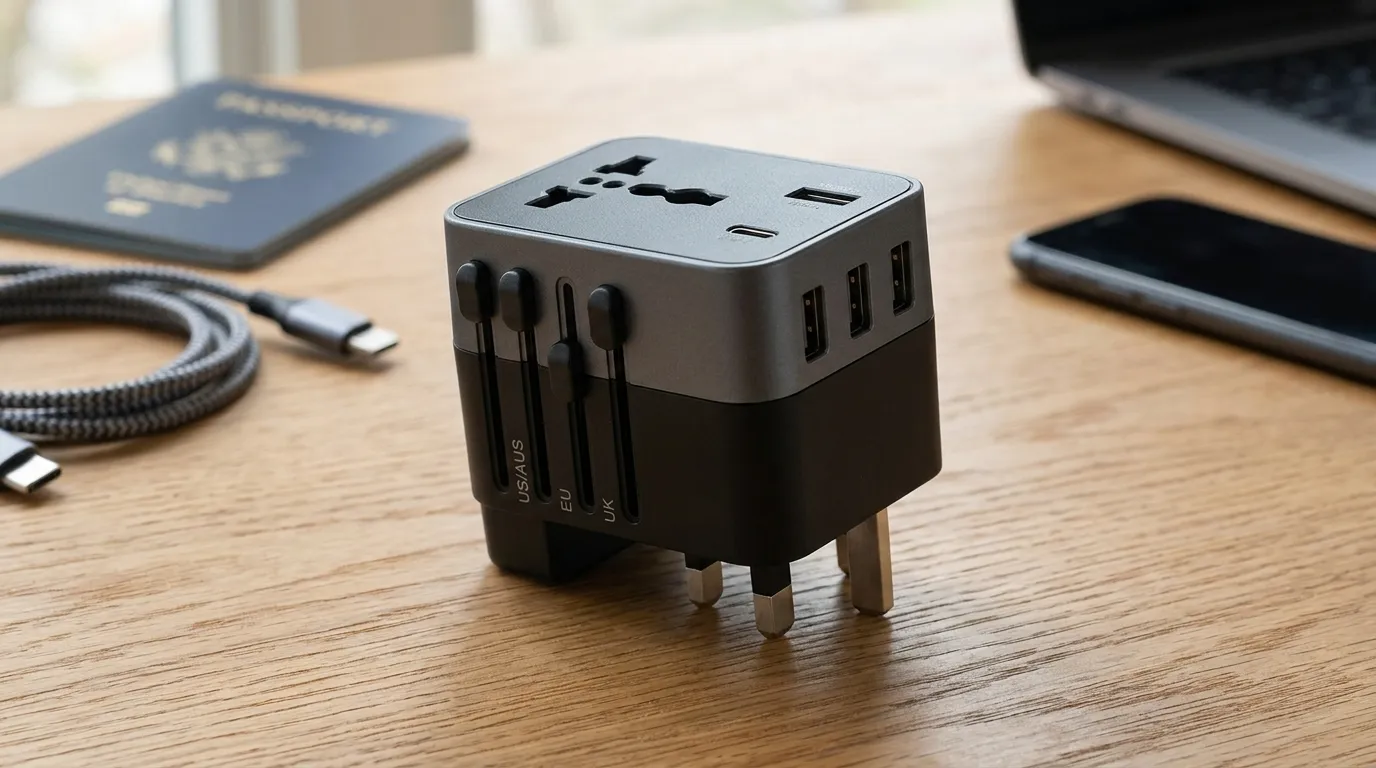
The most expensive mistake travelers make is confusing a physical socket adapter with an electrical voltage converter.
- Plug Adapters: These simply rearrange the physical pins so your domestic plug fits into an overseas wall socket. They pass the wall’s native electrical current directly to your device without altering voltage or frequency.
- Voltage Converters / Transformers: These step up or step down electrical pressure—typically shifting 220–240V (standard across Europe, Asia, and Oceania) down to 110–120V (standard across North America).
To determine what you need, inspect the tiny text printed on your device’s power brick. Look for the “INPUT” line:
- If it reads
100-240V ~ 50/60Hz, your device is dual-voltage. Laptops, smartphones, tablets, camera battery chargers, and modern e-readers are almost universally dual-voltage. You only need a standard mechanical plug adapter. - If it reads
110V ~ 60Hzor120V ~ 60Hz, your device is single-voltage. Plugging this directly into a 230V outlet using only a physical adapter will blow internal fuses, damage the hardware, or trigger a fire hazard. Single-voltage devices are commonly motor- or heating-element-driven: travel kettles, hair straighteners, clippers, and curling irons.
Universal All-in-One vs. Modular Dedicated Adapters
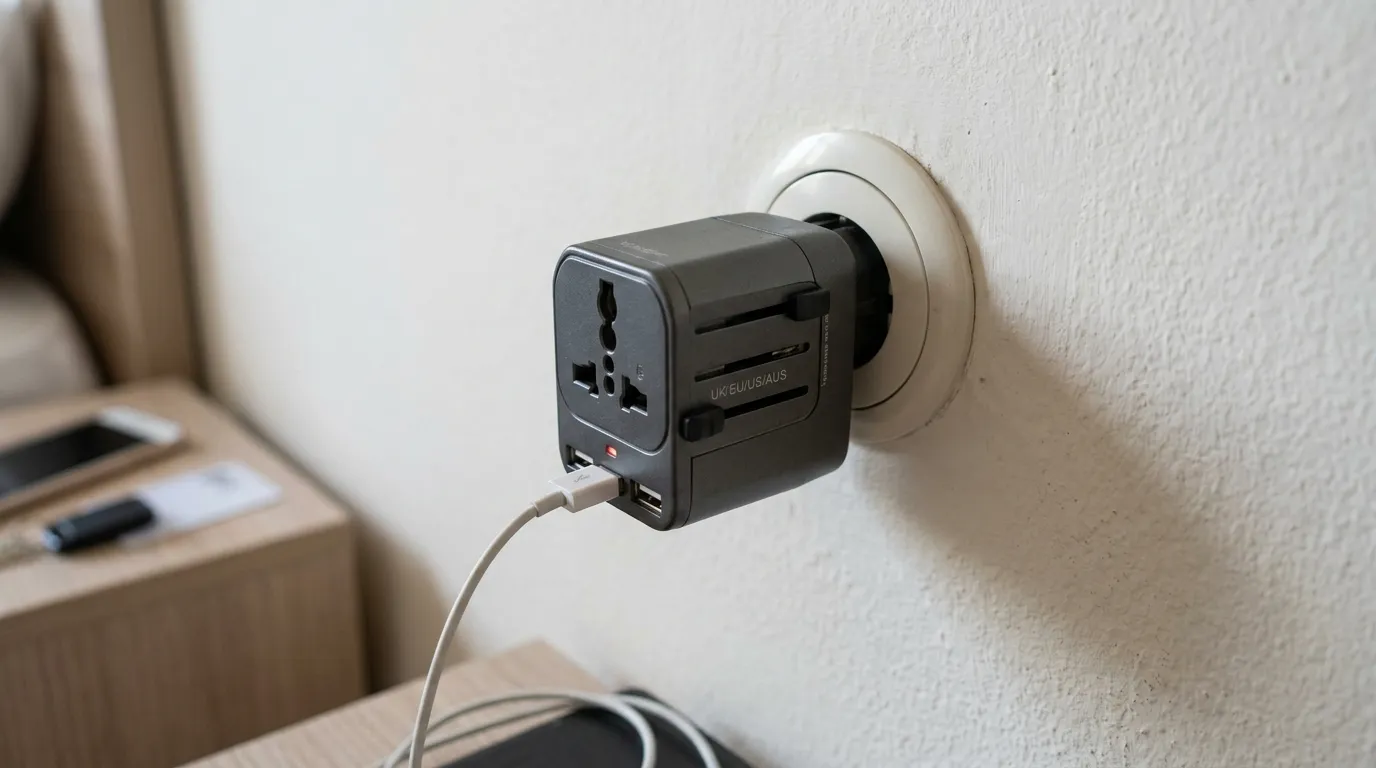
Choosing the best format depends on your itinerary, luggage space, and power draw needs.
Universal “Slider” Multi-Adapters
These boxy cubes feature slide-out prongs covering Types A, C, G, and I in one single unit.
- Pros: Impossible to leave individual prongs behind; broad multi-country compatibility for complex layovers or multi-leg journeys.
- Cons: Bulky and heavy. On older or loose wall receptacles (frequently encountered in trains, older hotels, and hostels), the weight of the cube can cause it to sag or slide out of the wall completely.
Dedicated Single-Country Plugs
Individual, molded plastic adapters dedicated to a single standard (e.g., standard US-to-UK Type G block).
- Pros: Compact, ultralight, highly durable, and seat securely in wall receptacles without sagging.
- Cons: You must carry multiple distinct pieces when crossing borders, making them easier to misplace in transit.
Integrated GaN Travel Chargers
Modern GaN (Gallium Nitride) travel hubs integrate high-wattage USB-C ports directly into an adapter chassis with interchangeable international prongs. Rather than carrying an adapter and your standard laptop brick, an all-in-one 65W or 100W GaN unit powers your computer, phone, and headphones directly from USB ports, streamlining your kit down to a single compact item.
Field-Tested Packing Rules for International Travel
- Beware of Recessed Outlets: Sockets across continental Europe (Type E/F) are recessed deep into the wall plate. Broad, flat-faced multi-adapters often cannot seat deep enough into the socket housing to make electrical contact. Ensure your adapter has an extended or stepped neck.
- Pack a Lightweight Power Strip for Groups: If you travel with family or partner gear, carry one single high-quality international plug adapter alongside a lightweight, non-surge-protected domestic power strip. You adapt one outlet to power three or four domestic plugs simultaneously. (Note: Ensure the power strip is rated for up to 250V and contains no surge protection circuitry, as US surge protectors can short-circuit when exposed to 230V).
- Carry a Spare USB-C Cable in Carry-On: Modern airports, long-haul trains, and airplanes increasingly provide native USB-C or USB-A receptacles directly at your seat, bypassing the need for wall prongs until you reach your lodging.
Frequently Asked Questions
Can I use a regular travel adapter for my hairdryer or curling iron?
Only if the styling tool is explicitly labeled as dual-voltage (100–240V). Most domestic hair dryers draw between 1,200 and 1,800 watts and operate solely at 110–120V. Running a single-voltage heating tool on a 220–240V circuit with just a plug adapter will burn out the heating coils almost instantly. In most cases, buying a dual-voltage travel dryer or relying on your hotel’s provided unit is safer and lighter than packing a heavy voltage converter.
Why do some travel adapters have a fuse built into them?
British standards (Type G) and many universal adapters feature replaceable or auto-resetting ceramic fuses (usually rated at 6A, 8A, or 10A). These protect delicate electronics and domestic wiring against excessive current draws and power surges. If your adapter suddenly stops working overseas, check whether the internal fuse has blown or if an integrated reset button needs to be pressed.
Which plug type is used universally across Europe?
The Europlug (Type C) is the most universal ungrounded plug across continental Europe, featuring two round prongs that fit sockets across France, Germany, Spain, Italy, Greece, and beyond. However, high-draw grounded equipment in Germany and Austria uses Type F (“Schuko”), while France and Belgium use Type E. The United Kingdom, Ireland, Malta, and Cyprus do not use Europlugs; they require the three-pronged Type G standard.