Executive Summary
- Wattage is comparable, but duration differs: Most air fryers and convection toaster ovens draw between 1,400 and 1,800 watts, but air fryers typically cook small batches 20% to 30% faster due to high-velocity airflow.
- Volume determines efficiency: Air fryers use significantly less electricity for single-to-double servings, whereas convection toaster ovens consume less energy per portion when cooking larger family meals on multiple racks.
- Preheating makes the biggest difference: Air fryers reach peak cooking temperature in under two minutes, cutting idle energy draw compared to the larger cavity of a convection toaster.
The Core Math: Wattage vs. Total Cooking Duration
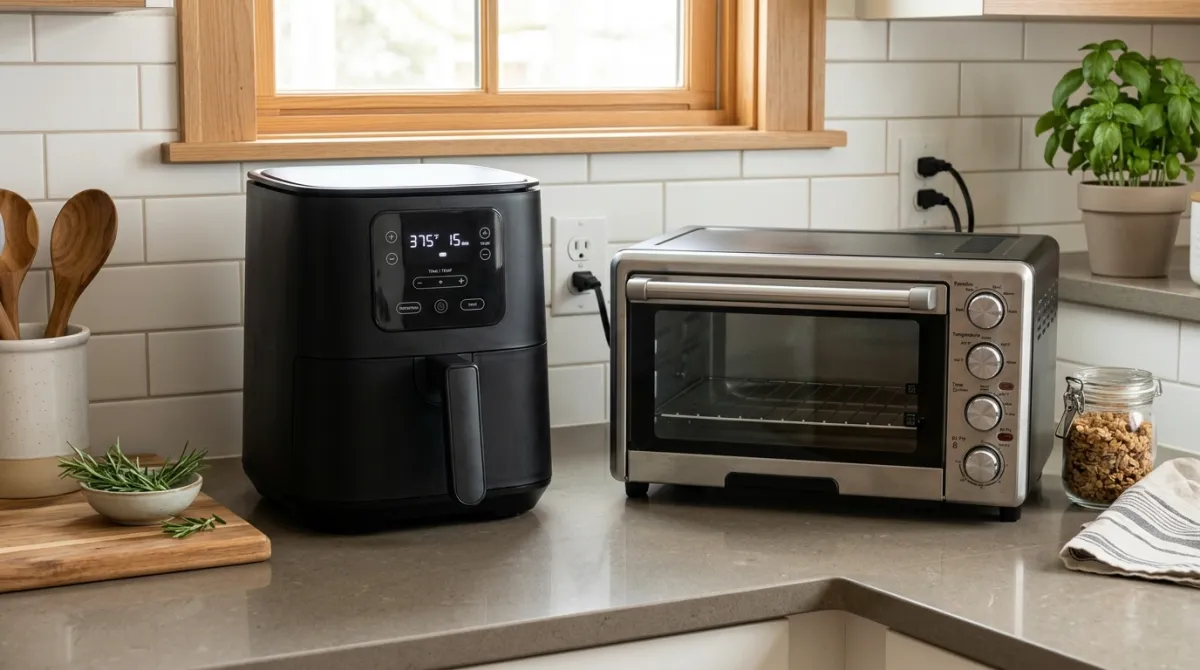
When analyzing air fryer vs convection oven power consumption, rated wattage only tells half the story. Both appliances typically run on a standard 120-volt household circuit, pulling between 1,400 and 1,800 watts at peak load.
Energy consumption is measured in kilowatt-hours (kWh), calculated as:
$$\text{kWh} = \frac{\text{Watts} \times \text{Hours of Use}}{1,000}$$
| Appliance Type | Typical Wattage | Preheat Time | Average Run Time (Dinner Batch) | Total kWh Used |
|---|---|---|---|---|
| Standard Basket Air Fryer | 1,500W | 1–2 mins | 15 mins | ~0.38 kWh |
| Convection Toaster Oven | 1,800W | 5–8 mins | 25 mins | ~0.75 kWh |
| Full-Size Wall Oven (Electric) | 3,000W–4,000W | 15–20 mins | 35 mins | ~2.50 kWh |
Because an air fryer’s heating element operates inside a compact, tightly sealed chamber with high fan speed, it transfers heat into food rapidly through convection currents. This drastically cuts cook times, resulting in roughly 40% to 50% lower total kilowatt-hour consumption for daily quick meals compared to larger countertop convection ovens.
Cavity Size and Thermal Dynamics Compared
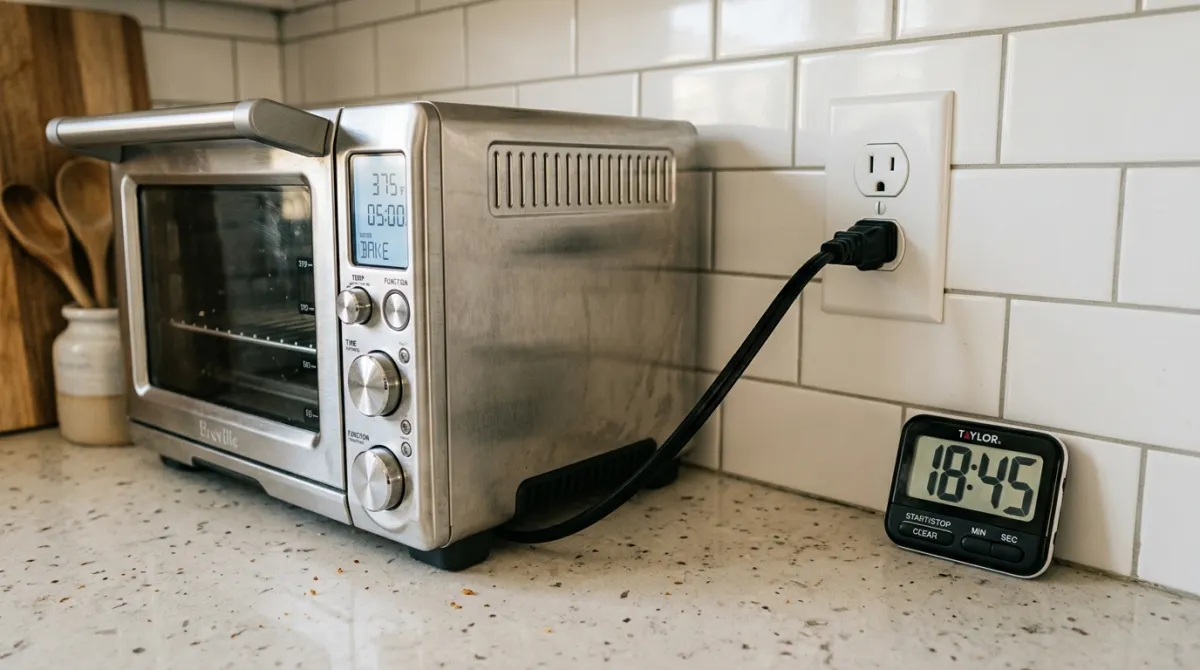
The primary reason an air fryer uses less power in short cycles comes down to cubic capacity and air circulation mechanics.
1. Air Fryer Airflow Velocity
Basket-style air fryers feature a powerful top-mounted fan positioned directly above the heating coil. This pushes concentrated, high-velocity heat over a small area (typically 3 to 6 quarts). Because the surface area to volume ratio is low, the heating element cycles off more frequently once target temperatures are reached, reducing active power draw.
2. Convection Toaster Oven Capacity
A countertop convection toaster oven has a larger footprint (often 15 to 30 liters) designed to fit baking pans, 12-inch pizzas, or multiple toast slices. The internal fan distributes air over a wider space at a lower velocity. It takes longer to bring this larger internal volume to temperature, and the heating elements remain powered on for longer stretches during a cooking cycle.
Real-World Scenarios: When Each Appliance Wins
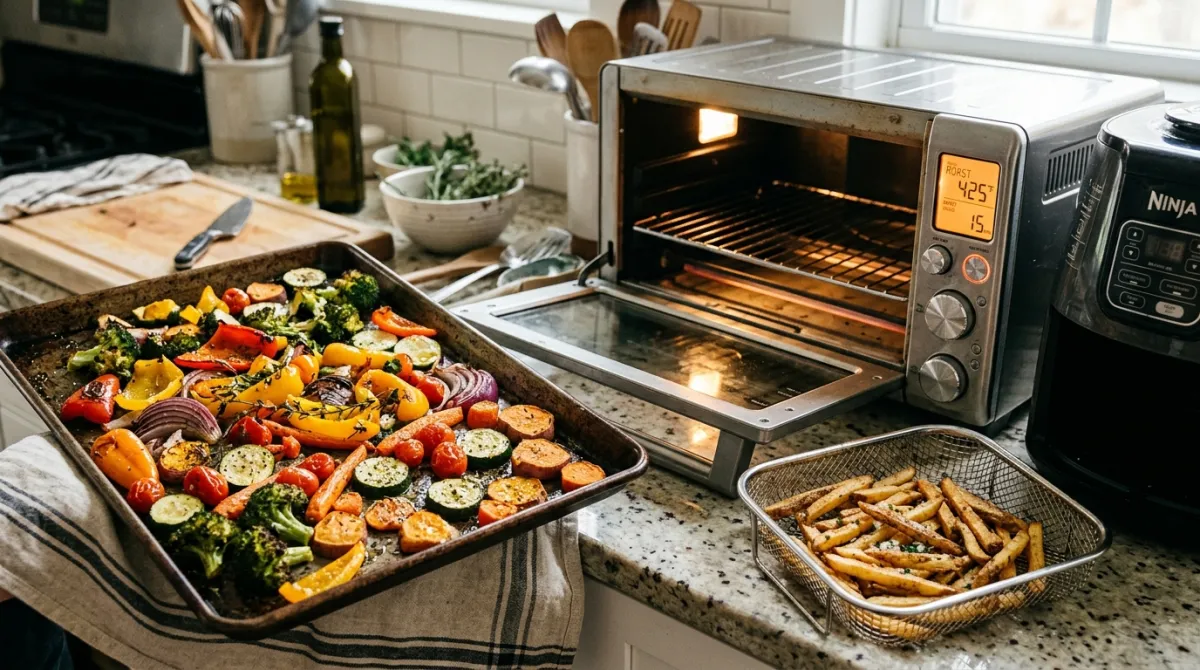
While standard math favors the air fryer for single items, specific cooking habits flip the energy equation.
When the Air Fryer Uses Less Electricity
- Reheating leftovers and crisping sides: Reheating a slice of pizza or cooking frozen fries takes 4 to 8 minutes with virtually zero preheat.
- Single or dual-portion meals: Cooking two chicken breasts or a small tray of vegetables takes 12 to 15 minutes.
- Quick breakfast prep: Toasting pastries or cooking breakfast sausages in short 5-minute bursts.
When the Convection Toaster Oven Uses Less Electricity
- Multi-component family meals: If feeding four people requires running an air fryer three times sequentially (3 × 15 minutes = 45 minutes of total runtime), you consume more energy than running one 30-minute cycle in a large convection toaster oven.
- Baking multi-rack dishes: Sheet-pan dinners, large casseroles, or baked goods that require uniform, steady heat across a wide surface area benefit from the toaster oven’s wider racks.
How to Minimize Countertop Cooking Energy
Regardless of which appliance sits on your kitchen counter, simple operational adjustments can lower overall electricity draw:
- Avoid unneeded preheating: For roasted vegetables, chicken wings, or frozen foods, preheating is largely unnecessary. Place the food in directly before turning the machine on.
- Minimize door and basket openings: Opening an air fryer basket drops the internal temperature by 25°F to 50°F almost instantly. Use viewing windows and internal lights when available instead of opening the door.
- Maintain internal cleanliness: Grease deposits on heating elements and reflective walls decrease radiant heating efficiency, forcing elements to stay energized longer to maintain set temperatures.
- Use foil or silicone liners correctly: Do not cover entire perforated air fryer baskets with solid foil, as restricting airflow extends cook times and negates the appliance’s thermal speed advantages.
Frequently Asked Questions
Does an air fryer use significantly less power than a full-sized electric oven?
Yes. A standard built-in kitchen oven consumes 2,500 to 5,000 watts and requires up to 20 minutes just to preheat. An air fryer typically consumes 1,500 watts and requires little to no preheat time, reducing total electricity consumption by 70% to 80% for small-to-medium meals.
Is an air fryer just a mini convection toaster oven?
Conceptually, yes. Both appliances use heating elements and fans to circulate hot air. However, air fryers use a much more compact chamber and a higher-speed fan, which creates intense radiant convection heat that cooks smaller food volumes faster than a traditional convection toaster oven.
Will switching to an air fryer noticeably lower my monthly electric bill?
The savings depend on how often you substitute the air fryer for a full-size conventional oven. If you use an air fryer daily instead of heating a 3,500W wall oven, you can save between 1.5 and 2.5 kWh per meal, leading to modest annual savings on household utility costs while reducing kitchen heat buildup during warmer months.