Disclosure: ClearPick Digest is supported by its readers. If you buy through links on this page, we may earn a commission at no extra cost to you. Read our affiliate disclosure.
Executive Summary
- Airflow dictates crispiness: Successful air fryer cooking relies on space between ingredients rather than added oil, as concentrated convection currents must envelop food surface area continuously.
- Master templates beat static formulas: Standardized heat-and-time ratios (such as 380°F for tender proteins and 400°F for root vegetables) allow you to adapt any pantry staple without guessing.
- Moisture control is essential: Surface dryness before seasoning and opting for high-smoke-point oils with non-aerosol dispensers preserve crisp coating and protect appliance nonstick coatings.
The Core Mechanics: Why Air Fryer Formulas Outperform Static Recipes
Most cooking mishaps occur when home cooks treat an air fryer like a miniature toaster oven. In reality, an air fryer operates as a high-velocity convection chamber. A heating element positioned right above a high-RPM fan pushes dry, rapid air through a compact basket, stripping surface moisture from ingredients to produce the Maillard reaction with a fraction of traditional deep-frying oil.
Understanding this thermal transfer changes how you execute air fryer recipes. Rather than memorizing dozens of disconnected cooking instructions, categorize ingredients by moisture retention and density. High-starch vegetables require higher heat at shorter intervals to avoid desiccation, while dense proteins benefit from moderate heat to render fat evenly before a final high-heat blast to crisp the exterior.
Essential Everyday Air Fryer Recipes and Ratio Templates
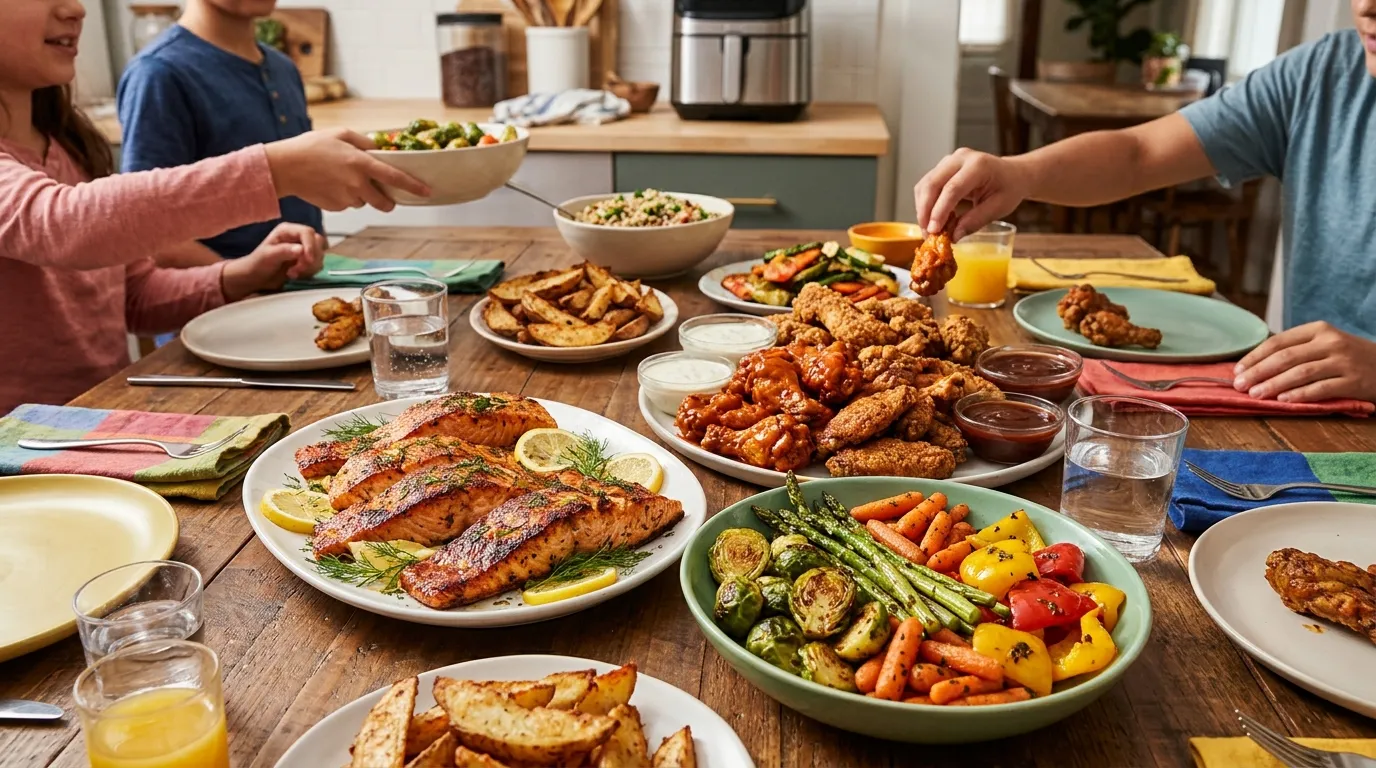
Instead of relying on rigid ingredient measurements, master these three foundational templates that apply to dozens of everyday meals.
1. The High-Heat Crispy Vegetable Template
- Best for: Broccoli florets, cauliflower, Brussels sprouts, asparagus, green beans.
- Ratio: 1 lb vegetables + 1 tablespoon high-heat oil (avocado or refined olive oil) + 1 teaspoon coarse kosher salt + dry spices.
- Technique: Cut produce to uniform size. Toss in a mixing bowl until a light sheen coats every crevice. Set the air fryer to 390°F (199°C) for 10–14 minutes, shaking the basket halfway through.
- The Result: Blistered edges with a tender interior, bypassing the soggy texture typical of standard sheet-pan roasting.
2. The Golden Protein Template
- Best for: Chicken thighs, seasoned tofu cubes, salmon fillets, pork chops.
- Ratio: Single-layer cutlets patted completely dry with paper towels + thin oil emulsion or dry spice rub.
- Technique: Cook at 375°F (190°C) for 12–16 minutes depending on thickness. Finish at 400°F (204°C) for the final 2 minutes if you want extra surface crackle.
- The Result: Juiciness trapped inside with an evenly browned, crisp outer barrier.
3. The Re-Crisp Carbohydrate Template
- Best for: Leftover pizza, roasted baby potatoes, homemade pita chips, frozen snacks.
- Ratio: No additional oil required for pre-cooked items; 1 teaspoon oil for raw tubers.
- Technique: Cook at 350°F (177°C) for 4–7 minutes. The gentle convection restores texture without scorching delicate crusts or evaporating residual moisture.
Critical Mistakes That Ruin Air Fryer Textures
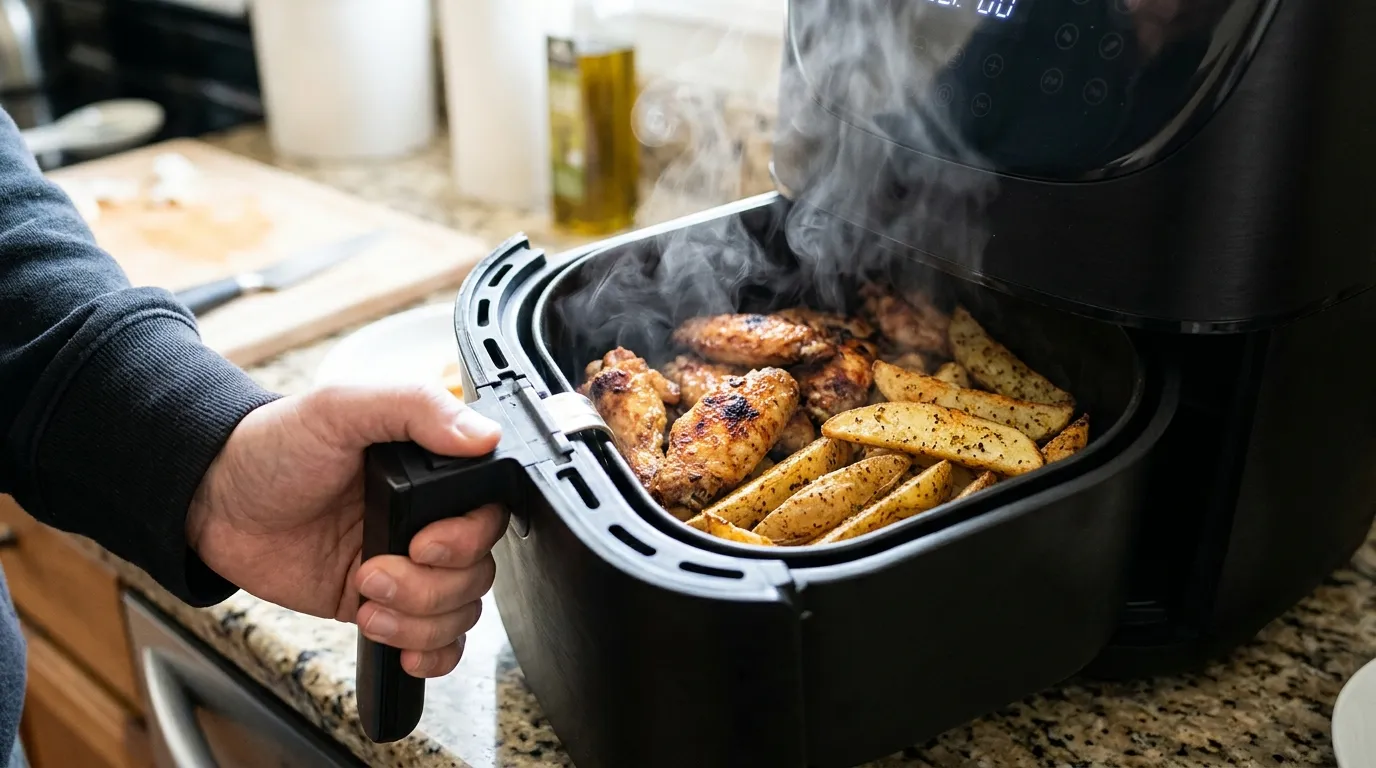
Even the best air fryer recipes fall short when minor prep details are overlooked. Avoid these four common pitfalls:
Overcrowding the Basket
Piling ingredients on top of one another blocks the directional fan draft. When air cannot circulate beneath and between the pieces, the appliance creates steam instead of convection heat. Cook in two sequential batches if necessary; the residual basket heat makes the second round cook 15–20% faster.
Using Wet Batters
Liquid batters formulated for deep fryers (like beer batter or tempura) will drip through the slotted basket floor before the heat can set them. For air frying, always transition through a standard dry-dredge sequence: flour, egg wash, followed by panko or seasoned breadcrumbs that lock onto the surface immediately.
Relying on Aerosol Nonstick Sprays
Commercial non-aerosol cooking sprays often contain propellants like soy lecithin and isobutane. Over multiple heating cycles, these agents polymerize on nonstick basket coatings, creating a sticky, stubborn residue that degrades heat transfer. Invest in a refillable oil mister filled with pure avocado or light olive oil.
Neglecting the Shake Step
Small, lightweight items like chickpeas, cubed potatoes, and shredded kale tend to settle unevenly. A quick manual basket toss at the midpoint redistributes exposure to the upper heating coil, guaranteeing uniform crisping without scorching the top layer.
Temperature & Timing Matrix for Common Ingredients
Keep this reference guide handy when adapting traditional kitchen staples to convection settings:
| Ingredient | Prep Style | Temp (°F) | Time (Mins) | Mid-Point Action |
|---|---|---|---|---|
| Chicken Breast | Boneless, pounded flat | 375° | 12–15 | Flip at minute 7 |
| Chicken Wings | Patted dry, dry rub | 400° | 18–22 | Shake every 6 mins |
| Salmon Fillets | Skin-on, lightly oiled | 380° | 8–11 | No flip needed |
| Baby Potatoes | Halved, lightly oiled | 390° | 16–20 | Shake at minute 10 |
| Firm Tofu | Pressed, cubed, cornstarch | 380° | 14–16 | Shake at minute 8 |
| Brussels Sprouts | Halved, cut-side down | 375° | 12–15 | Shake at minute 7 |
Note: Appliance wattages vary between 1,200W and 1,800W. Check internal temperatures with an instant-read meat thermometer to ensure food safety.
Frequently Asked Questions
Do I need to preheat an air fryer for every recipe?
While some manufacturers claim preheating is unnecessary, giving the chamber 2 to 3 minutes to reach temperature creates a thermal shock that seals the exterior of proteins and root vegetables immediately. Skip preheating only for delicate baked goods or when reheating pizza crusts that scorch easily.
Can you put parchment paper or aluminum foil in an air fryer?
Yes, but with strict safety precautions. Never run the preheat cycle with empty parchment paper, as the updraft will pull the paper directly into the exposed heating element, creating a fire risk. Always weigh paper or foil down with food, and choose perforated parchment liners designed specifically to let convection air circulate freely.
Why do some air fryer recipes turn out dry instead of crispy?
Dryness usually stems from setting the temperature too low for too long, which evaporates internal hydration before the surface browns. Increase the cooking temperature by 15°F to 25°F and reduce the duration. Applying a very light mist of oil also conducts surface heat more efficiently, crisping the outer layer before internal moisture escapes.